A camera makes it possible to take a photograph. It does not, by itself, tell the photographer which moment is worth capturing, what should be in the frame, or whether the image communicates anything useful.
AI creates a similar challenge for business and technology leaders. Producing a proposal, a product concept, or a working piece of software is becoming easier. Deciding whether the result deserves to exist still requires serious attention.
In my experience, this makes the human contribution more important today. Domain knowledge, accumulated experience, taste, and judgment influence what we ask for, what we notice, and what we accept. A person who understands the business can recognize a problem that is invisible in an otherwise impressive output.
But I disagree with a conclusion often attached to this argument: that these capabilities will remain exclusively human forever.
I expect agents to take on more of them over time. The timing and the extent will vary, but I would not build a leadership strategy around the assumption that machines will never develop useful judgment or taste.
The task is to use our expertise well today while learning how to delegate more of it tomorrow.
A better prompt begins with knowing what matters
Prompting is useful. Clear instructions, relevant context, examples, and constraints can improve the work we receive. However, knowing how to phrase a request is only part of knowing what to request.
Consider a hypothetical product leader reviewing an AI-generated onboarding flow. The screens may be attractive, the copy may be polished, and every button may work. Someone who understands the customer might immediately notice that the flow asks for a commitment before explaining the benefit.
The missing information is about the product, the customer, and the decision being made. A more elaborate prompt will help only if somebody recognizes that the information matters and supplies it.
This is where experience earns its place. It helps us see the assumptions inside a request. It also helps us distinguish a missing detail from a fundamentally misguided direction.
When AI makes execution faster, those distinctions can affect much more work. An unclear objective can now produce a large amount of competent-looking output before anyone asks whether it solves the right problem.
Taste means recognizing fitness for purpose
The word taste can sound subjective or cosmetic. In product work, I use it more broadly: the ability to recognize which result fits the purpose, the audience, and the situation.
A useful interface may have fewer features than an impressive demonstration. A good customer message may be shorter and less polished because the customer needs a direct answer. A sound technical choice may look ordinary because reliability matters more than novelty.
Taste draws on experience, but it should remain open to evidence. A senior person's preference does not automatically represent what customers need. If we cannot explain a choice or test its consequences, we should be careful about treating our instinct as a quality standard.
Ethan Mollick describes four advantages people can bring to AI: deep knowledge, wide knowledge, taste, and agency. His argument provides a useful starting point for considering how people influence the quality of AI-assisted work. Read “The Overhang.”
For leaders, I would bring domain knowledge and broader experience together under knowledge, retain taste and agency, and make judgment explicit. Knowledge helps establish what matters. Taste helps select what fits. Agency turns a possibility into action. Judgment weighs competing priorities and the consequences of a decision.
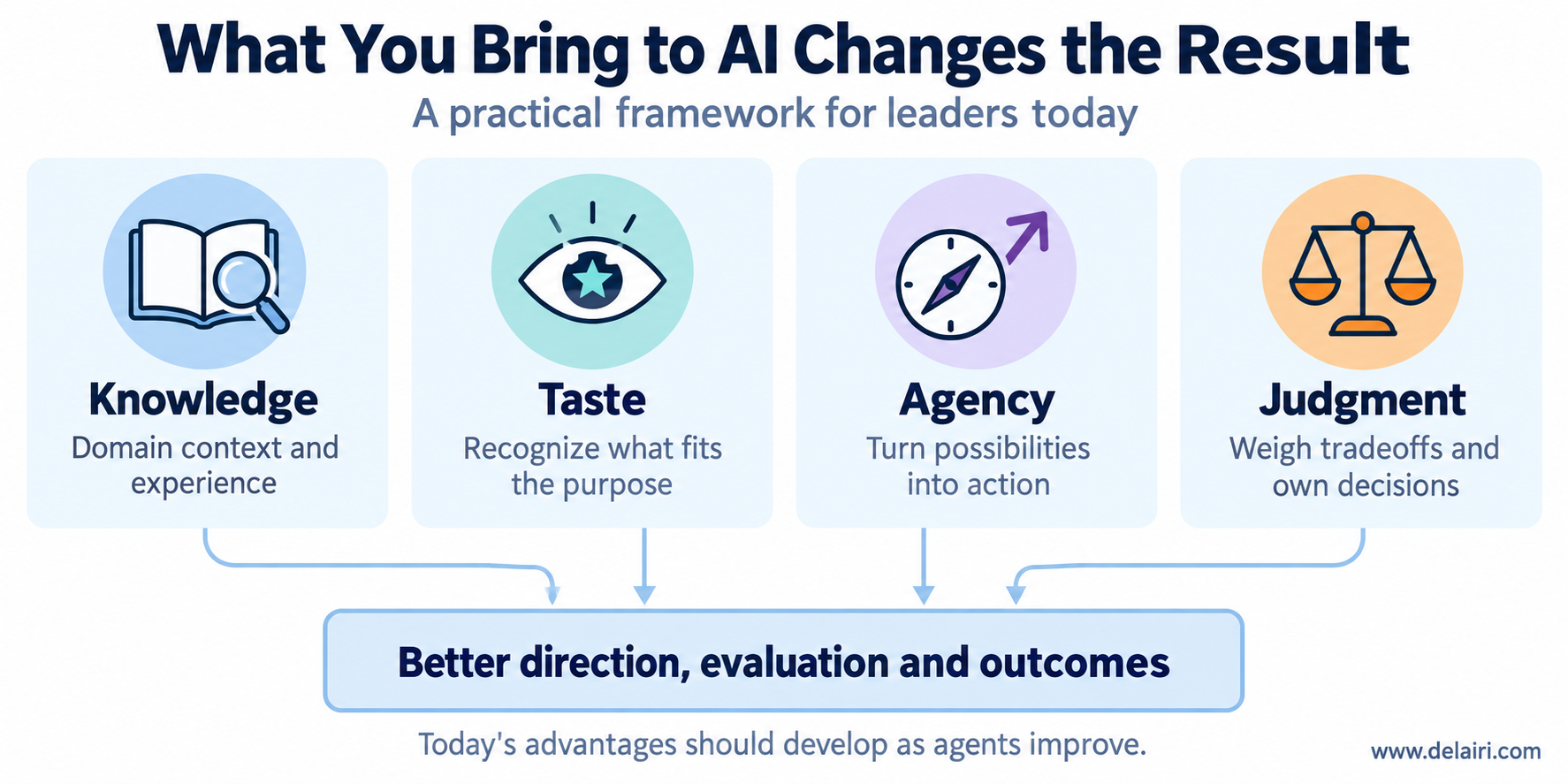
A practical leadership framework for today's work. It describes useful contributions, without assigning them permanently to humans.
Judgment includes the compromise you are willing to accept
Many business decisions involve several reasonable answers.
A team can launch sooner with a narrower feature set. It can invest more in reliability before expanding. It can choose a simpler architecture that meets current needs while accepting that parts may need replacing later.
An agent can help compare those options. The difficult part is deciding which consequences are acceptable in this particular business, with these customers, resources, and commitments.
Today, I place substantial value on people who can connect the immediate decision to that larger context. Their contribution includes recognizing when the question itself needs changing.
For example, asking how to build a requested feature assumes that building it is the right response. An experienced product leader might ask whether the underlying customer problem could be solved by removing a confusing step. A technical leader might recognize that another isolated solution will make an already fragmented system harder to operate.
Those observations are especially valuable when implementation is readily available. They direct the capability toward work worth doing.
Today's advantage is not a permanent boundary
I am cautious about statements that define judgment, creativity, or taste as things AI simply cannot do.
My experience tells me that human context and judgment are still necessary in the work I do. It does not tell me that every component of those capabilities is impossible to reproduce or delegate.
Some judgments can be described through examples, constraints, and feedback. We can explain why one response was clearer, why a design created unnecessary friction, or why an architectural choice caused problems. Over time, that gives us material for teaching both people and systems.
There is already research exploring a narrow version of this question. The September 2026 preprint The Tasteful Agent studies whether models can choose better directions during engineering and research tasks, and reports improvements through training. Its definition of taste is specific to decisions in those tasks; it does not establish broad business judgment or human-level aesthetic understanding. Still, it is a useful reminder that parts of what we call taste can become measurable capabilities. Read the paper.
My expectation is that delegation will extend beyond implementation into more evaluation, selection, and planning. That remains a forecast, with no fixed timetable. Leaders should test it against actual performance rather than turn either optimism or skepticism into a permanent rule.
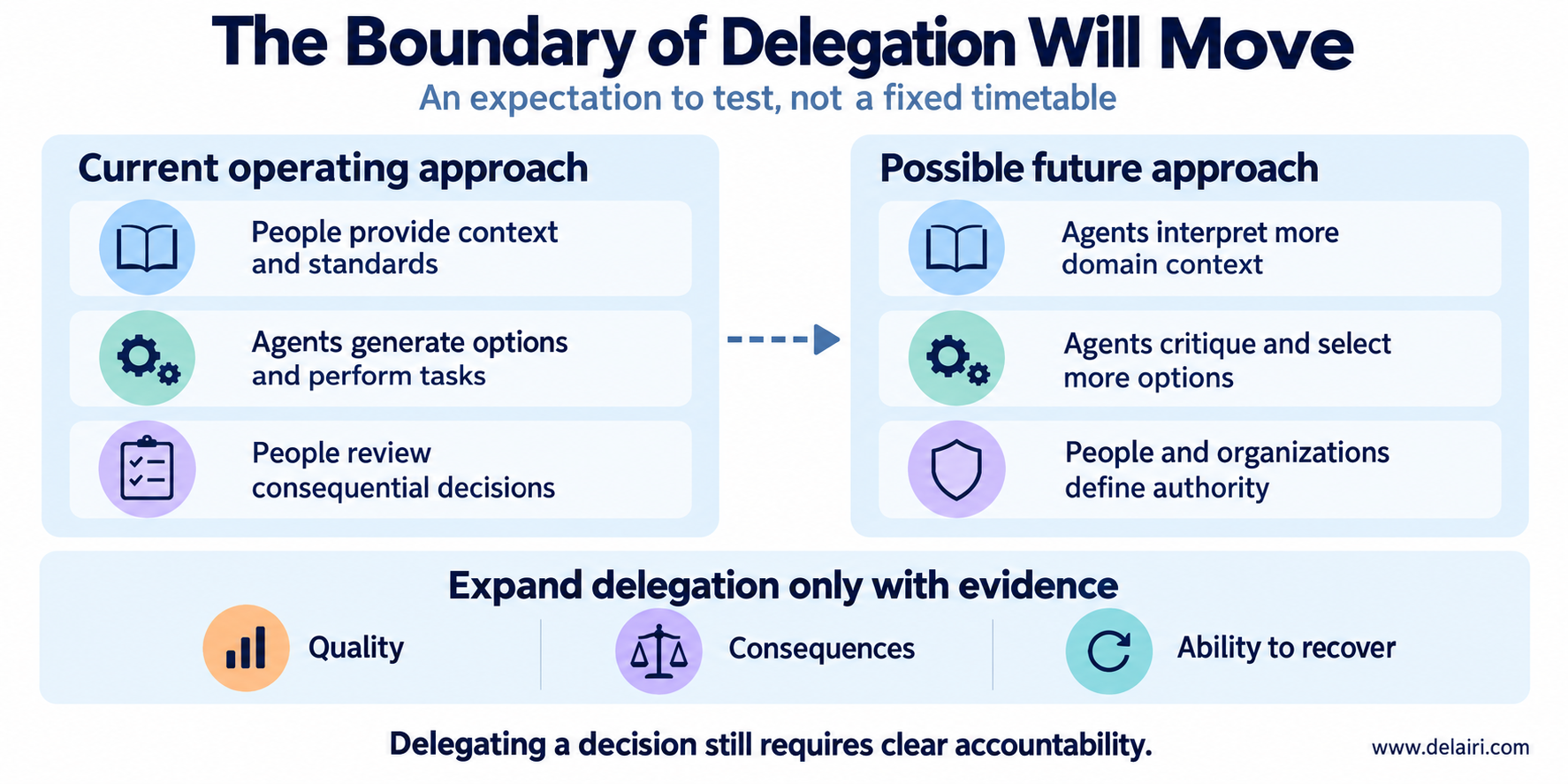
An expectation about how responsibilities may change. Quality, consequences and the ability to recover should determine the scope of delegation.
Make your standards available to the system
If a team depends entirely on one experienced person saying “this feels wrong,” it has a fragile way of maintaining quality.
The next useful step is to explain the reasons. Which customer need is being missed? Which constraint has been ignored? What makes an alternative better? What evidence would change the decision?
In the onboarding example, the team could record the purpose of each step, show examples of clear and confusing explanations, and identify points where customers hesitate. Those materials could guide an agent's first draft and its subsequent review.
A second agent might challenge the proposal from another perspective. That can be useful, but agreement between agents is not proof. They may share assumptions, overlook the same context, or optimize for a standard that was poorly defined.
Actual user behavior and business outcomes still need to inform the evaluation. The review process should be able to detect when a confidently presented answer fails in practice.
As those records improve, the organization gains something more durable than a collection of clever prompts: an explicit account of what good work means in its own environment.
Develop judgment while delegating work
There is a leadership challenge here that goes beyond today's output. People develop expertise partly by doing work, receiving feedback, and seeing what happens afterward.
If agents produce the draft, compare the options, and offer the final recommendation, a less experienced colleague could become an approver without learning how the judgment was formed.
I would deliberately preserve opportunities to reason. Ask people to assess an option before seeing the agent's recommendation. Have them explain disagreements, investigate failures, and follow decisions through to their consequences. Use agents to expose alternatives and challenge assumptions.
This is also useful for experienced leaders. AI gives us another way to test our own confidence. A decision that survived for years without explanation may deserve a fresh examination.
The aim is to build a team that can understand and improve the work, including the parts it delegates. That ability will matter as the scope of delegation changes.
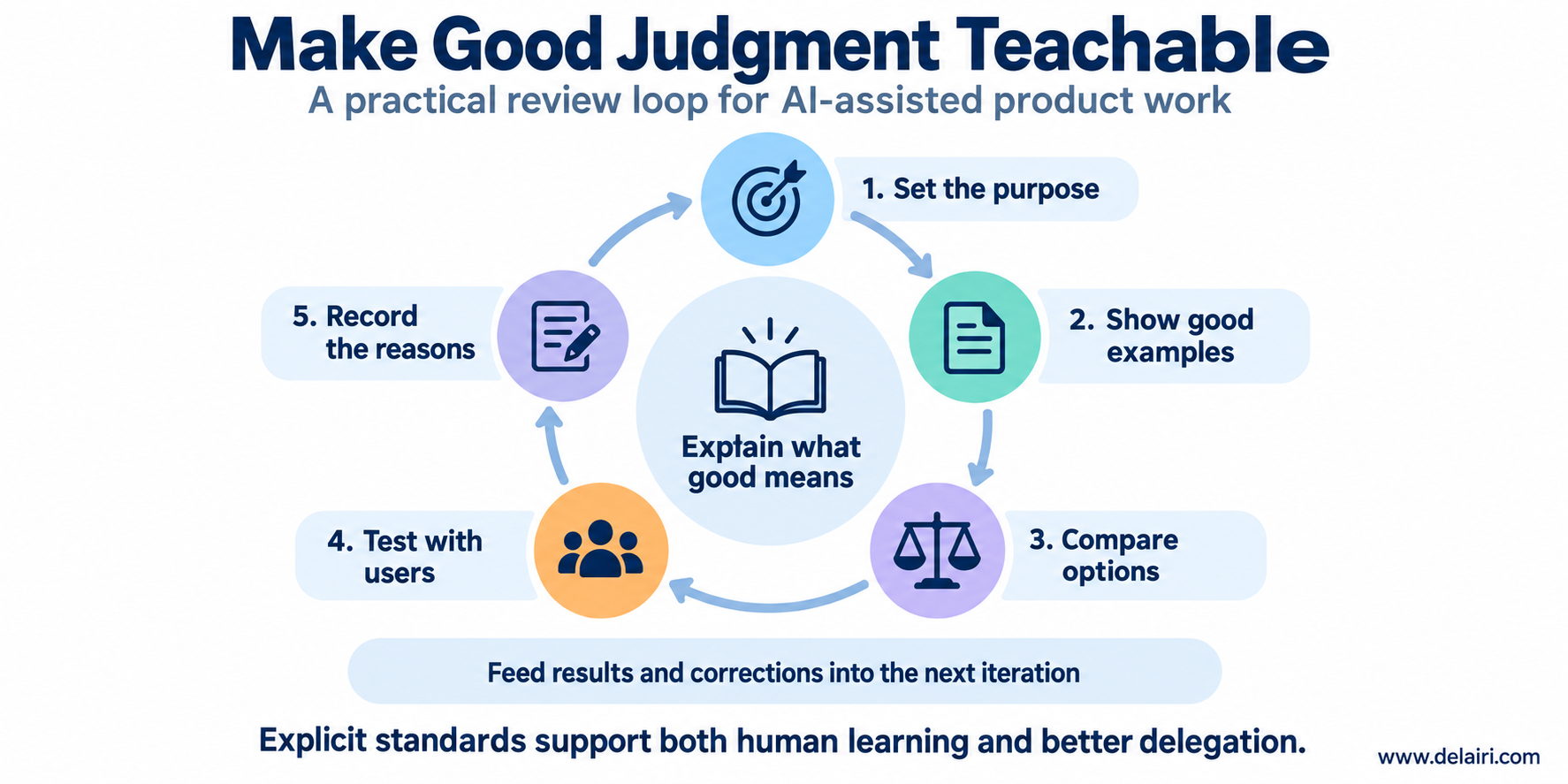
Making quality standards explicit supports human learning and gives agents better context for future work.
Accountability needs an owner even when decisions are delegated
An agent may eventually make a particular choice more reliably than a person. A business still needs a way to determine its authority, observe its performance, and respond when circumstances change.
I would treat those as operating responsibilities. Who defines the objective? Who decides which consequences are acceptable? Who can stop the system or change its instructions? Where does a customer go when something goes wrong?
Answering these questions does not require a belief that people will always outperform machines at making decisions. It requires a business to take responsibility for the systems it chooses to use.
For leaders, the immediate opportunity is substantial. Bring your domain knowledge into the work. Explain your standards. Make room for experimentation. Follow the results. Then revisit which responsibilities can be delegated as the evidence changes.
I believe human expertise matters enormously in this transition. I also believe its role will continue to evolve. The advantage belongs to people and organizations that use what they know to direct better work, while remaining willing to learn that some of that work can now be done another way.