A familiar cloud-computing lesson is becoming an agent-product problem: making a resource easy to consume also makes it easy to consume more than expected.
Imagine you are a product manager building an application that has agents doing tasks for users. Now, this problem moves closer to the user’s request and is no longer a cloud computing problem. Someone asks for a research brief, an application change, or a comparison of suppliers. The system has agents and decides which tools to use, how many attempts to make, and whether to delegate parts of the work. A simple request can create a surprisingly complicated chain of paid activity.
The user may never see that chain. They still need to understand what they have agreed to spend.
I have 2 decades of experience building products in corporate settings. I am very interested in how organizations transition from traditional software product management to a more agentic world. I am building a community exchange platform, an iOS app, a content-delivery platform, and automations for day-to-day activities. Those projects have reinforced my interest in what individuals can now build with AI. They are not evidence that I have solved the economics of running agents inside a product, but I am going to keep learning and building to be prepared for the future.
I believe a spending limit should be part of the product’s promise to its customer.
The cheap request is only the beginning
Simon Willison’s October 3 argument for default hard budget caps highlights a practical gap: an email warning can arrive while automated spending continues. His post is a practitioner’s case for stronger defaults, not a study measuring how often agents overspend. It nevertheless identifies a useful product question: what actually stops the next charge? Source: Simon Willison, October 3, 2026.
A model’s price per token answers only part of that question. An agent might call a paid search service, process documents, start compute resources, repeat failed steps, or ask other agents for help. Even if each individual action looks inexpensive, the task can expand through repetition and branching.
The relevant unit for a product team is the accepted outcome. How much did it cost to produce a result the customer could actually use? Include the unsuccessful attempts and the review work needed to reach that point. Keep the metered technical bill visible, while also measuring the human effort it does not capture.
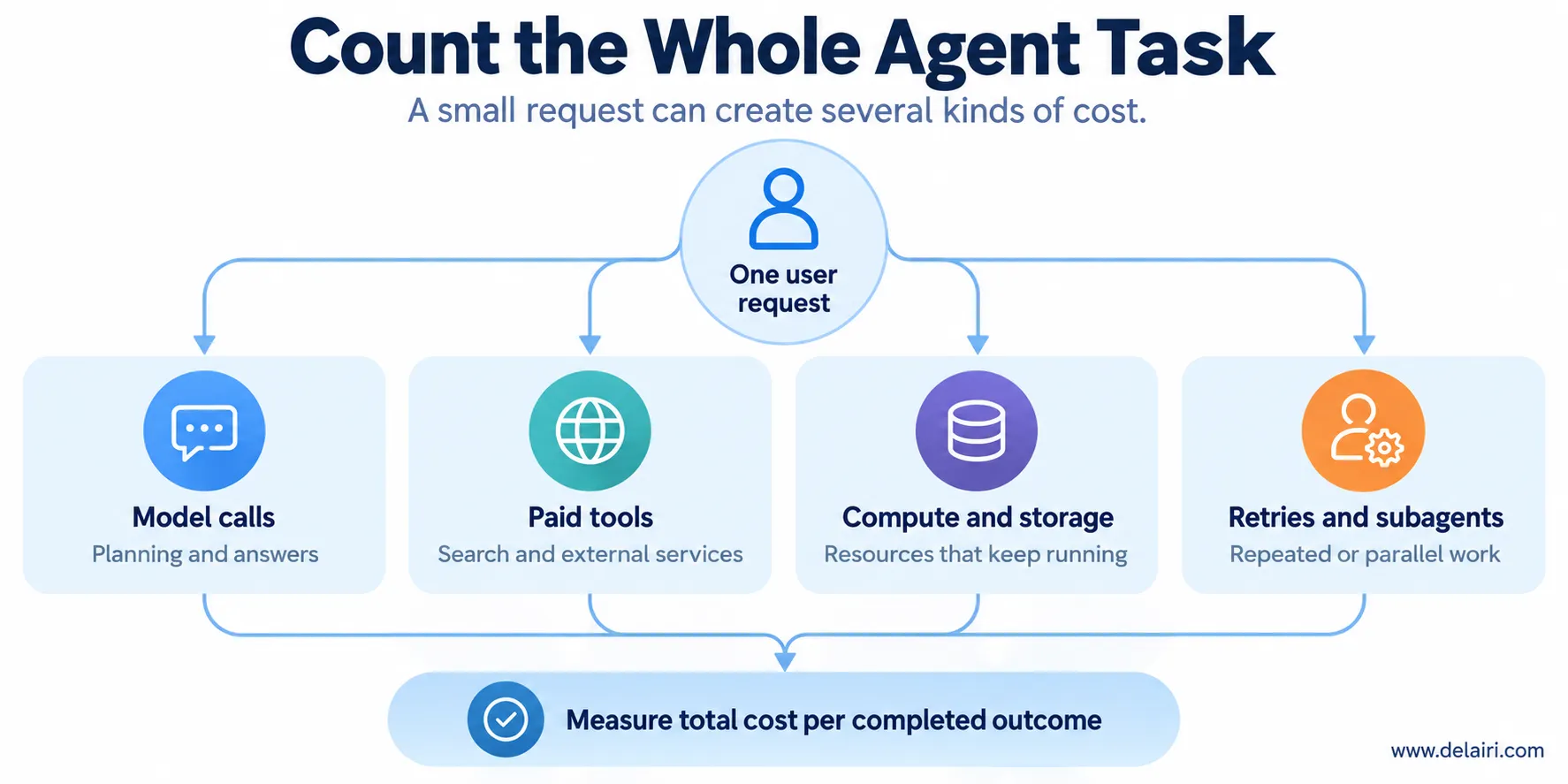
The cost of a task includes the resources it consumes. Retries and subagents can multiply those costs; they are not a separate accounting category to add twice.
A low average is encouraging, but it can hide the tasks that behave very differently. Product teams should inspect the expensive unfinished cases alongside the successful ones. Those cases reveal where an agent keeps working after the value of another attempt has become questionable.
Define the allowance before the work expands
Consider a hypothetical product that prepares a supplier comparison. It can read provided documents, look up missing information, and produce a brief with sources. The customer chooses a bounded allowance for that task.
The first design decision is what the allowance covers. Does it include paid search? Document processing? The work of delegated agents? Can the system provision resources that continue billing after the comparison is finished? An allowance that covers only the main model call leaves much of the product’s behaviour outside the customer’s understanding.
The second decision is who bears the charge. In a subscription product, the company may absorb some variability within its plan. In a usage-based product, the customer may pay directly. Either arrangement still needs an internal limit and a clear explanation of what happens when it is reached. Packaging the cost differently does not remove it.
The third decision is how a task relates to larger limits. A single request may fit its own allowance while hundreds of requests exhaust a project’s monthly budget. Both boundaries matter. A recurring automation also needs a rule for how many times it may run and when its allowance resets. Otherwise, a sensible limit on one execution can become an unexpected ongoing commitment.
The product should make these decisions explicit before it asks the user to trust its autonomy.
Every branch must draw from the same allowance
Giving each agent the full task budget would multiply the customer’s exposure as the system delegates. A parent task and its branches need shared accounting.
A useful design is to reserve estimated spending before a paid action begins, then reconcile that reservation with the actual charge. Concurrent branches must consult the same remaining allowance. If several actions are already running, the system needs to count their commitments before deciding that another action can start.
This checking belongs in the software that controls execution. A sentence in a prompt asking the model to stay within budget is not an enforceable limit. The model can help plan economical work, but the product must control which paid actions it permits.
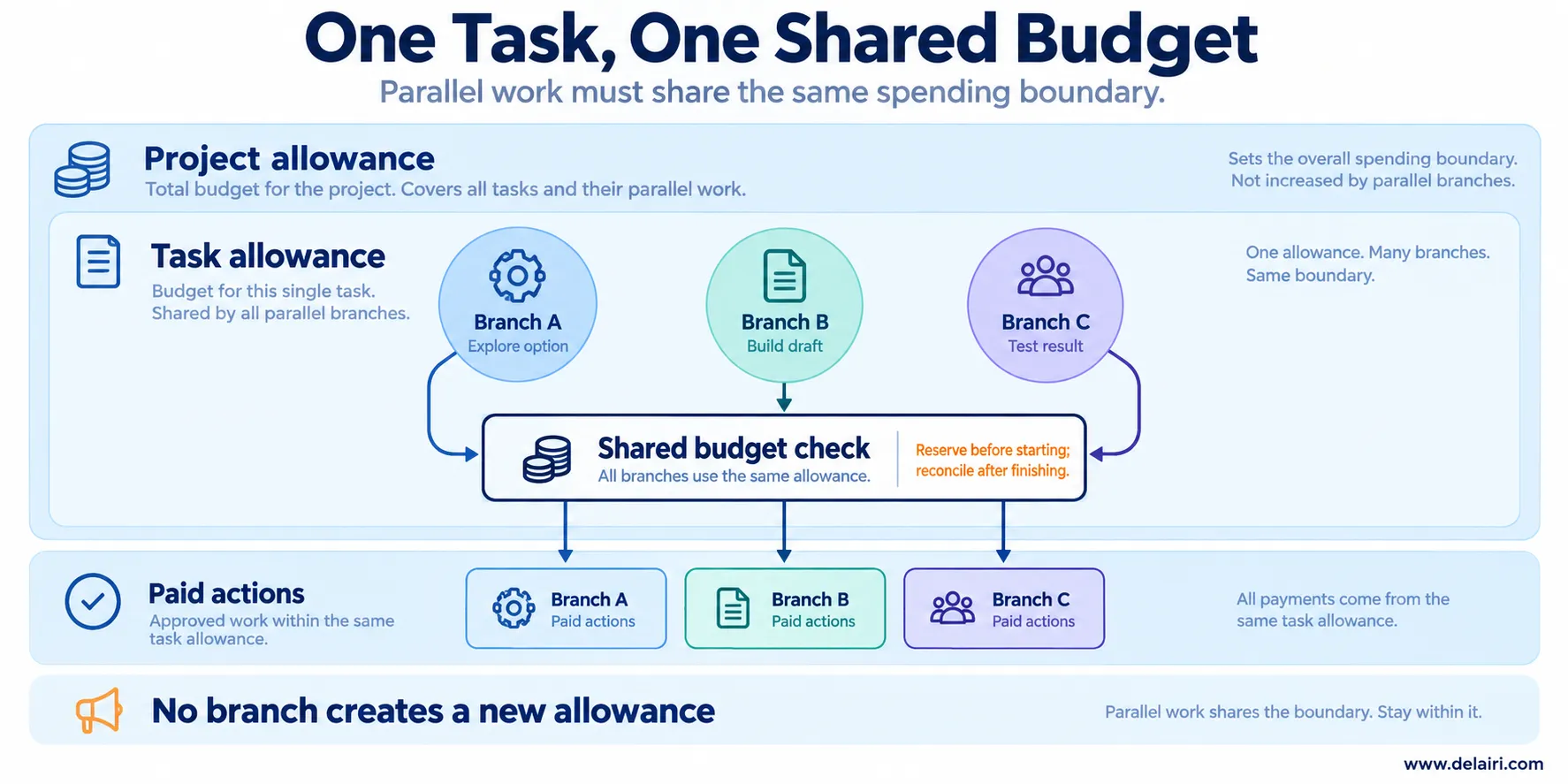
Proposed design principle: delegated work inherits the original spending boundary. Creating another branch does not create another allowance.
There are practical limits to precision. Prices may be known only after an operation finishes. Billing data can lag. A resource can incur a continuing charge after new work stops. The product should reserve headroom and explain any residual exposure rather than advertising an absolute guarantee it cannot enforce.
Google Cloud’s July 29 spend-cap announcement provides useful background. Its preview covered specified services, described enforcement within minutes, and noted that fixed commitments could continue billing. Those qualifications matter: a provider cap is one layer of protection, with service-specific behaviour. It does not automatically define the complete experience of an application built on top. Source: Google Cloud, July 29, 2026.
Design the moment the budget runs out
A limit is easy to describe when everything finishes within it. The product becomes more interesting when the work remains incomplete.
Return to the hypothetical supplier comparison. The agent has extracted the supplied material and verified several claims, but a gap remains. More paid research would exceed the allowance. A generic failure message would throw away the user’s understanding of what has already been accomplished.
A better handoff explains four things: what is complete, what remains uncertain, what caused the pause, and which bounded options are available next.
The user might accept the partial brief, narrow the question, or authorize an additional allowance. An extension should state the new limit. It should not quietly switch the task to unlimited spending or restart every step that has already been completed.
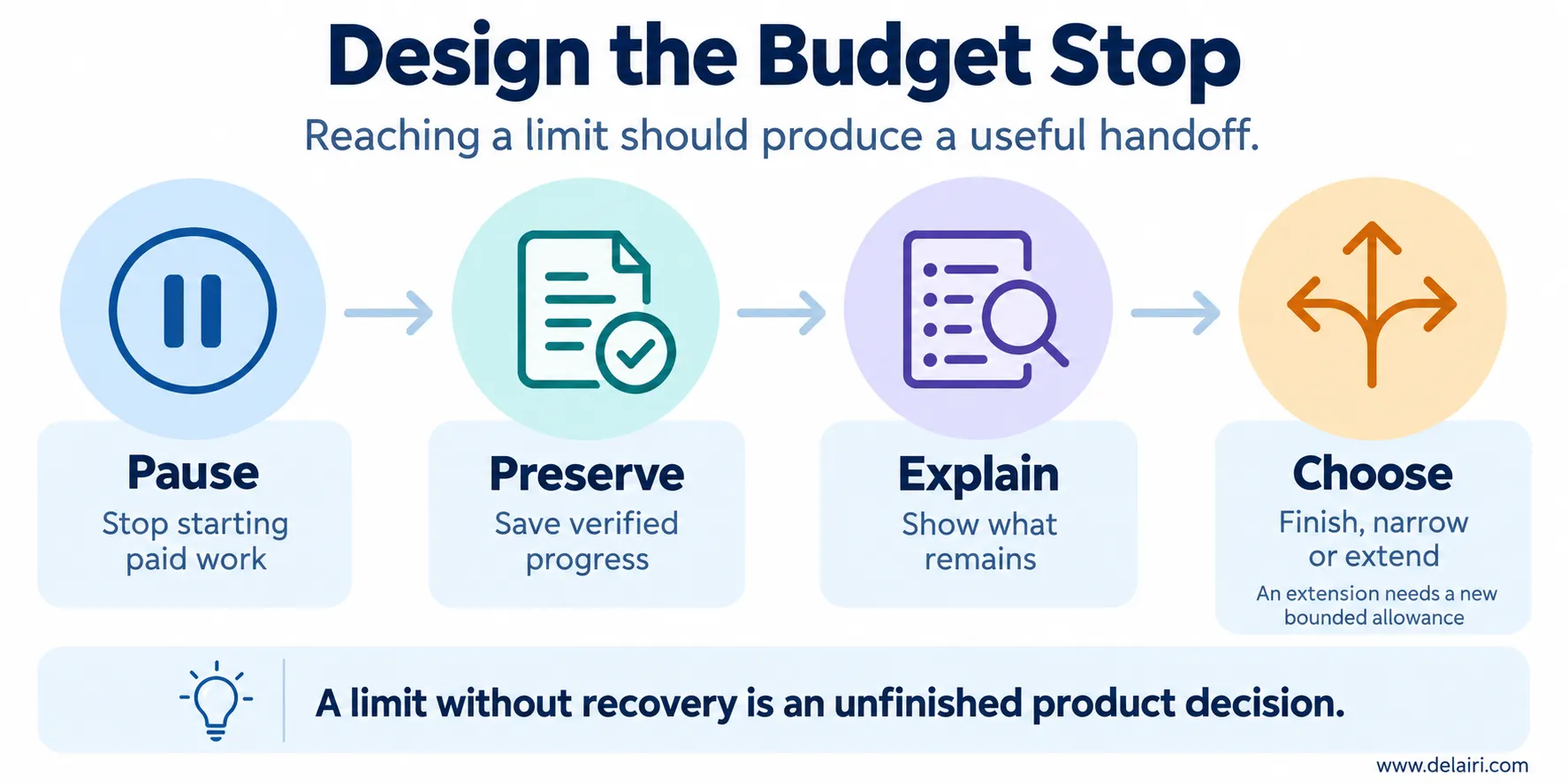
Pause new paid work, preserve verified progress, explain the remaining gap, and offer a bounded next decision.
Preservation also requires care. Save the work in a form the user can retrieve, subject to the product’s retention rules. Make clear whether any resources still need to be shut down. Reserve enough capacity for this handoff before the task consumes its entire allowance; otherwise, even the explanation may require spending that is no longer available.
The budget stop needs as much design attention as the successful result.
Put the economics into product review
This changes the questions a product leader should ask in a demonstration.
Ask to see a normal completion, an expensive incomplete task, and several branches trying to spend at once. Observe what the system preserves when an external service fails. Check whether a retry consumes the same allowance or accidentally creates a new one. Confirm that cancellation prevents new commitments and clearly identifies charges already in progress.
Then evaluate the result from the customer’s perspective. Could they predict their exposure? Could they understand the pause without reading execution logs? Could they recover useful work? Did the lower cost come from genuine efficiency, or from producing an answer that required much more correction?
These questions connect engineering behaviour with pricing, customer support, and trust. They also help distinguish a product that is economical in a short demonstration from one whose behaviour customers can understand during repeated use.
More capable agents may become better at estimating effort and choosing economical plans. That is a reasonable possibility, not a reason to leave the spending boundary implicit today. Better planning and enforceable limits serve different purposes.
The practical next step is small: choose one agent workflow, define its complete allowance, and design the experience at exhaustion. Test that experience with the same seriousness as the successful path.
An agent becomes easier to delegate to when its user can understand both what it is trying to accomplish and what it is allowed to commit along the way.