A dashboard turns a complex business into a smaller set of metrics that leaders can observe and compare. That is useful, but the selection of metrics also determines what remains invisible. Every number on the dashboard may be accurate while the overall picture is still incomplete because important customers, events or decisions are not represented.
AI-assisted customer research creates a similar challenge. AI can make it easier to conduct more conversations, organize transcripts and identify patterns across a larger body of evidence. In effect, it compresses many individual experiences into themes and summaries. The result may look comprehensive, but it still depends on who was interviewed, what was asked, what was missed and how the evidence was interpreted.
The opportunity is significant: hear from more people, explore meaningful differences and shorten the distance between a question and useful evidence. Realizing that value still requires deliberate research design.
More conversations expand the evidence available for learning. They do not determine what that evidence means.
For product and business leaders, the more important question is how the evidence changes a decision.
A New Study Makes the Opportunity Visible
On September 29, 2026, Anthropic opened a study using an AI interviewer, with optional public release of participants' interviews. It runs through October 6. The announcement explicitly notes that Claude users are not representative of the public and that people choosing public release form a further selected group. It also explains that interview content can reveal identity despite omitted account details. These are design limitations to consider, not findings from the still-running study. Read the study announcement and FAQ.
The wider lesson for product teams is that scaling conversations makes the surrounding choices more consequential. Who gets invited? Who feels comfortable responding? What does the interviewer ask next? How does the analysis handle disagreement?
Those questions existed before AI. A more efficient interview process gives us a reason to address them explicitly.
Begin with a Decision that Research Can Inform
“Understand our customers” is a useful ambition, but it is too broad to guide a particular study. A team needs to identify the uncertainty behind a decision.
Consider a hypothetical business deciding why customers abandon a document-submission process. Several explanations are possible. The instructions might be confusing. Customers might lack the required information. The service might ask for a commitment before establishing its value.
Each explanation suggests a different response. More helpful wording, a way to save progress and a change to the product proposition are different investments.
The research should help distinguish among those explanations. Asking people which features they want may produce interesting requests while leaving the original uncertainty unresolved.
Before recruiting participants, write down the decision, the current assumptions and what evidence would change the team's view. This keeps the interview program connected to a business decision instead of focusing on collecting more material.
Recruit for the Experiences you Might be Missing
The easiest customers to reach are not necessarily the people whose experience matters most to the decision.
A study drawn entirely from active, satisfied users may describe why the existing product works. It can tell us much less about people who tried it and stopped, never completed onboarding or decided against adopting it.
In the document-submission example, someone who successfully finished the process has a different perspective from someone who abandoned it midway. A purchasing decision-maker may see a different problem from the person who uses the service every day.
The point is not that every qualitative study needs to represent an entire population. A narrowly recruited group can provide useful insight. The conclusions should match the group and the question being investigated.
Keep a record of who was invited, who responded and which relevant experiences remain absent. More interviews within the same narrow group will not automatically repair that absence.
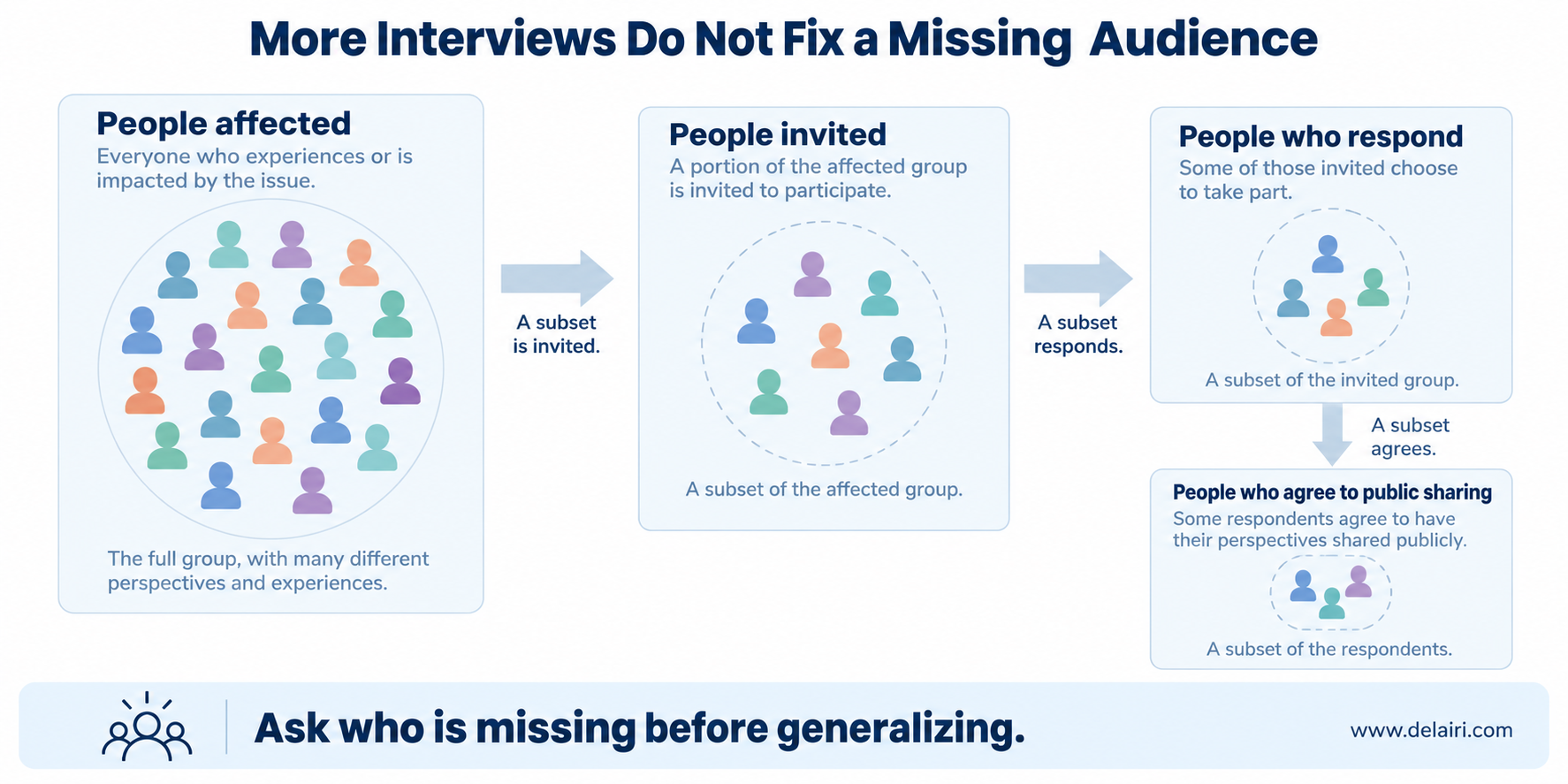
Conceptual subsets, not survey counts. Recruitment and participation determine which experiences enter the evidence.
The interview is an Interaction, not a Neutral Pipe
An automated interviewer asks questions, chooses follow-ups and reacts to what it receives. That behavior can influence the account a participant gives.
Compare asking “How helpful was the new workflow?” with asking someone to describe the last time they used it. The first question contains an assumption. The second provides room to discover what happened, including whether the person used the workflow at all.
Pilot the interview before scaling it. Inspect whether follow-ups clarify an answer, introduce a new assumption or lead the participant toward a conclusion. Check how the interviewer responds to uncertainty, contradictory statements and a request to stop.
Participants should understand that they are speaking with AI and how their responses will be used. The team should make space for questions an automated flow cannot handle well. A person may need another way to explain a sensitive or complicated experience.
In my experience, enterprise AI adoption comes with fear and anxiety about changing roles and job loss. An employee interview about AI should account for that context. People may reasonably choose their words differently when they are unsure who will read the transcript or what conclusions management will draw.
Keep the Path from Transcript to Recommendation Visible
An AI-generated summary can be a useful starting point. It should remain possible to inspect the evidence behind an important conclusion.
For each proposed theme, retain relevant excerpts and enough context to understand them. Distinguish what a participant said from the team's interpretation. Record accounts that do not fit the dominant pattern.
Suppose the research summary concludes that customers want fewer submission steps. A closer reading might reveal several different experiences: repeated entry of the same information, uncertainty about why a document is needed or concern about sharing sensitive details. Removing a step may help one group and leave the others' problems untouched.
The apparent agreement therefore needs examination. Similar words can point to different causes, and one strong story can draw more attention than several quieter accounts.
Review a sample of source material against the generated themes. Ask a second reviewer to challenge the interpretation where the decision is important. Agreement between two AI summaries is not enough by itself; both may simplify the same ambiguity.
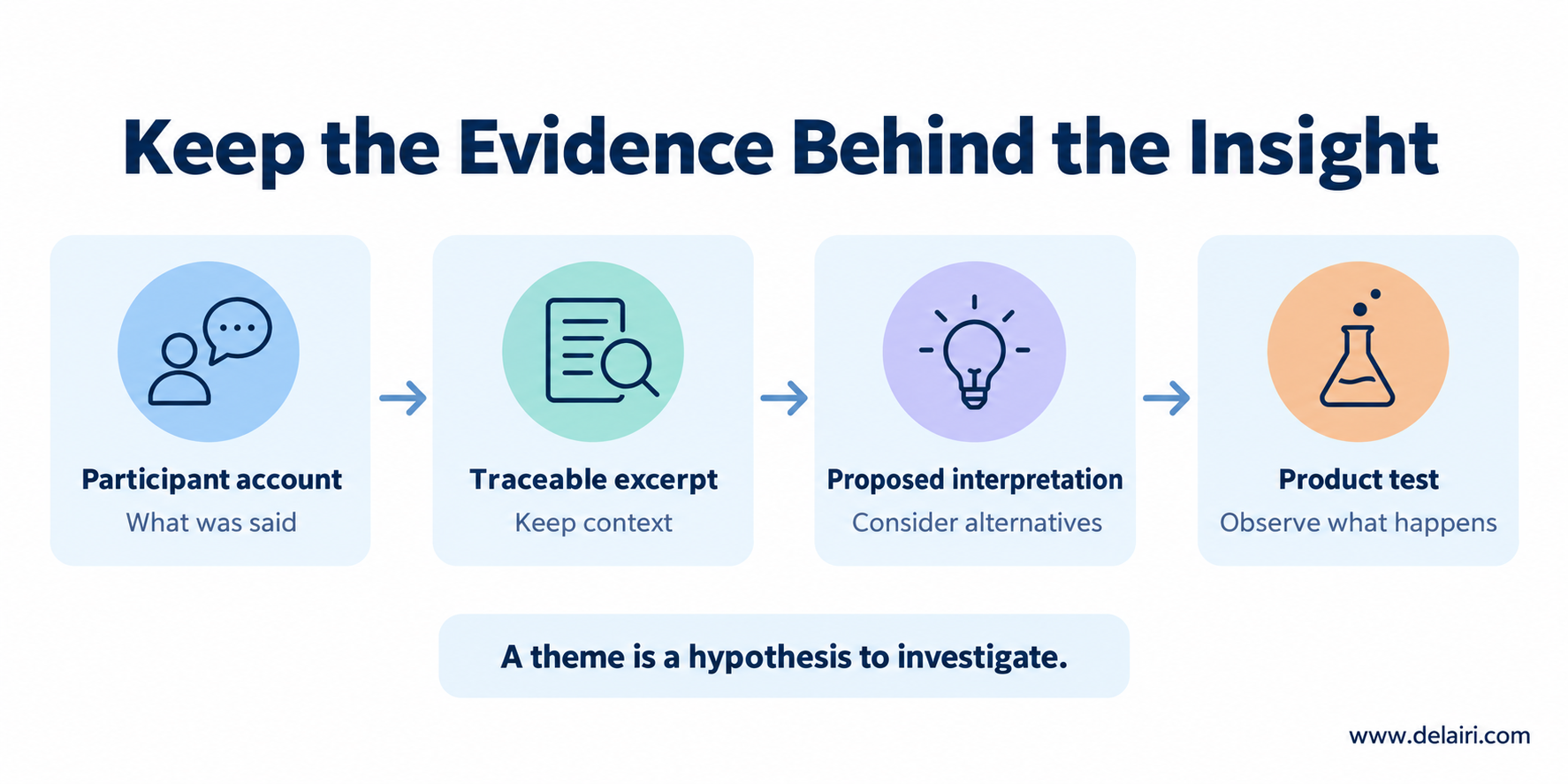
The proposed interpretation is a hypothesis. Preserving its source makes it easier to challenge and improve.
Treat Interview Data as Something People Entrusted to You
A transcript may contain more than a product opinion. Participants can mention colleagues, customers, internal work practices and events that make them recognizable.
Before collecting the conversation, decide which details are actually necessary, who can access the material and how long it needs to be retained. Explain those choices in language participants can understand. Participation and public quotation should be separate, deliberate decisions.
There is a practical product implication here. If people cannot understand how their words will be used, the research process itself can undermine trust. That is especially relevant when interviewing employees about tools supplied or evaluated by their employer.
The goal is to learn enough to make a better decision while avoiding unnecessary collection and exposure. A research program does not become more valuable simply because it stores a larger archive.
Connect Accounts with Behavior and a Test
Interviews help explain experiences, motivations and perceptions. They do not automatically establish what people will do after a product changes.
In the hypothetical submission workflow, the team can compare interview accounts with where users stop, what they attempt next and the support questions they raise. Differences between those forms of evidence can be informative. Someone may describe a process as straightforward yet repeatedly need assistance to finish it.
Use the combined evidence to design a small change. Perhaps the next test explains why a document is required before asking for it. Perhaps it allows customers to return later with missing information. Each test should address a particular explanation and include a way to observe whether the result improved.
That learning can lead to another round of interviews with a better question or a different group. Research becomes a loop connected to product decisions, rather than a report delivered at the end of discovery.
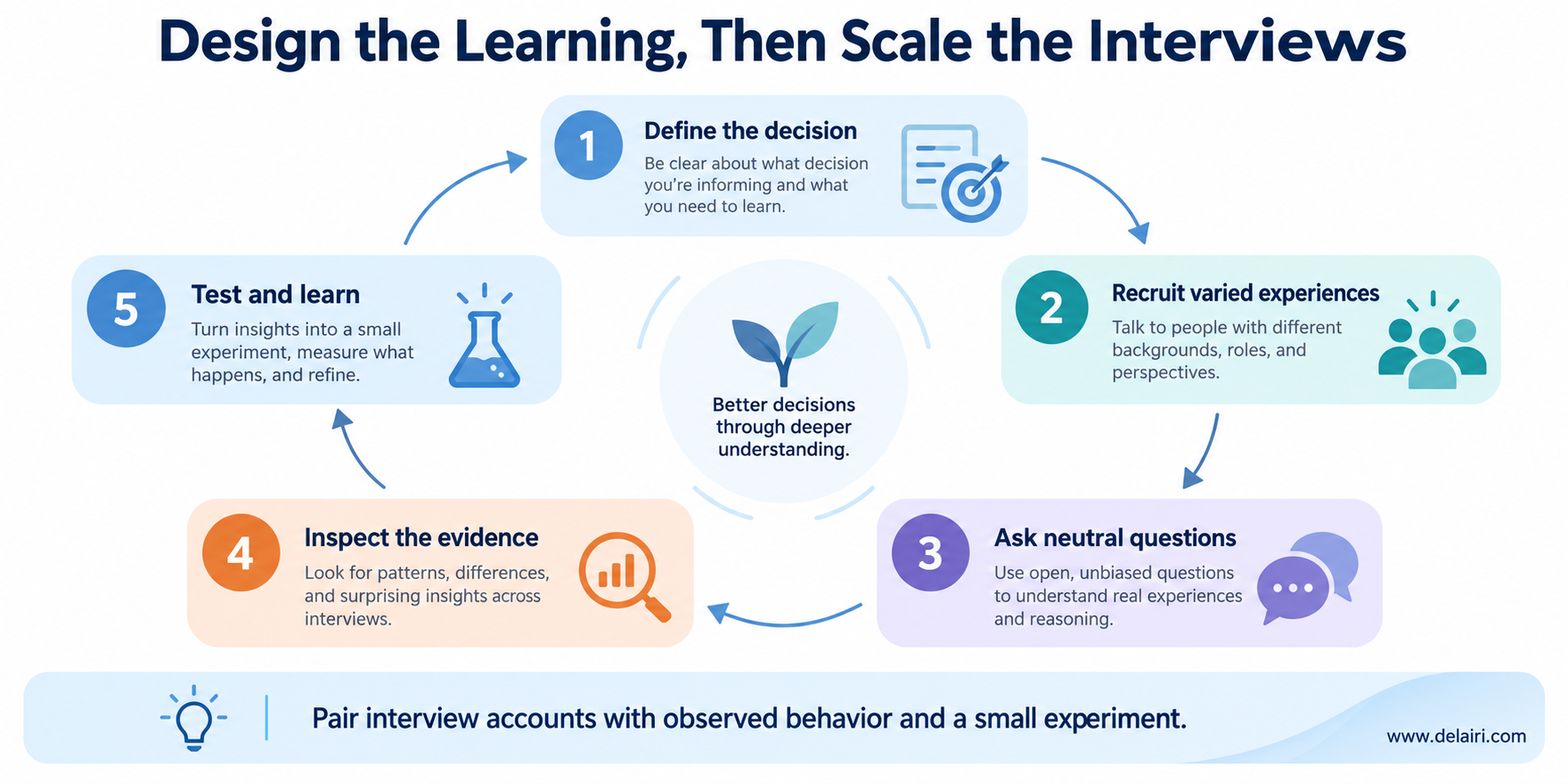
A practical research sequence. Scale the conversation when the design supports useful learning.
Measure what the organization learned
Interview volume is an activity measure. A more useful review asks which assumption changed, which decision became clearer and what the team will test next.
AI can help a smaller team reach more people and work through more material. The value comes from preserving the connection between those accounts and a decision that improves the product.
Before expanding an automated research program, review one complete chain: the question, the people included, the interview behavior, the evidence behind the interpretation and the resulting test. If that chain is weak, generating more transcripts is unlikely to make it strong.
Better customer insight comes from making the learning more disciplined and easier to examine. AI gives product teams another way to do that work, provided they design the research as carefully as they design the product.